How to tutor so the student can work independently
A one-hour lesson plan, questions for difficult moments, and a way to work with mistakes. Give the student time to start a new task independently.
A 60-minute tutoring plan
An example maths lesson: the student can solve simple equations but struggles with brackets. By the end, they solve a new equation and check the answer without prompts.
Recall without notes
Give 2x + 3 = 11. Instead of asking what you covered last time, watch whether the student can choose an operation and apply it to both sides.
“Solve it and check by substitution. How do you know your answer fits?”
If subtracting 3 is the obstacle, work on a simple equation first. Brackets can wait.
One diagnostic task
Give 2(x + 3) = 14 and ask for the reason behind the first step. Writing 2x + 3 = 14 identifies a point to work on; a wrong final answer alone does not.
“What does the two outside the brackets mean? Show what it multiplies.”
If they solve it independently, move to a harder variation. Skip an explanation they no longer need.
An example with less and less help
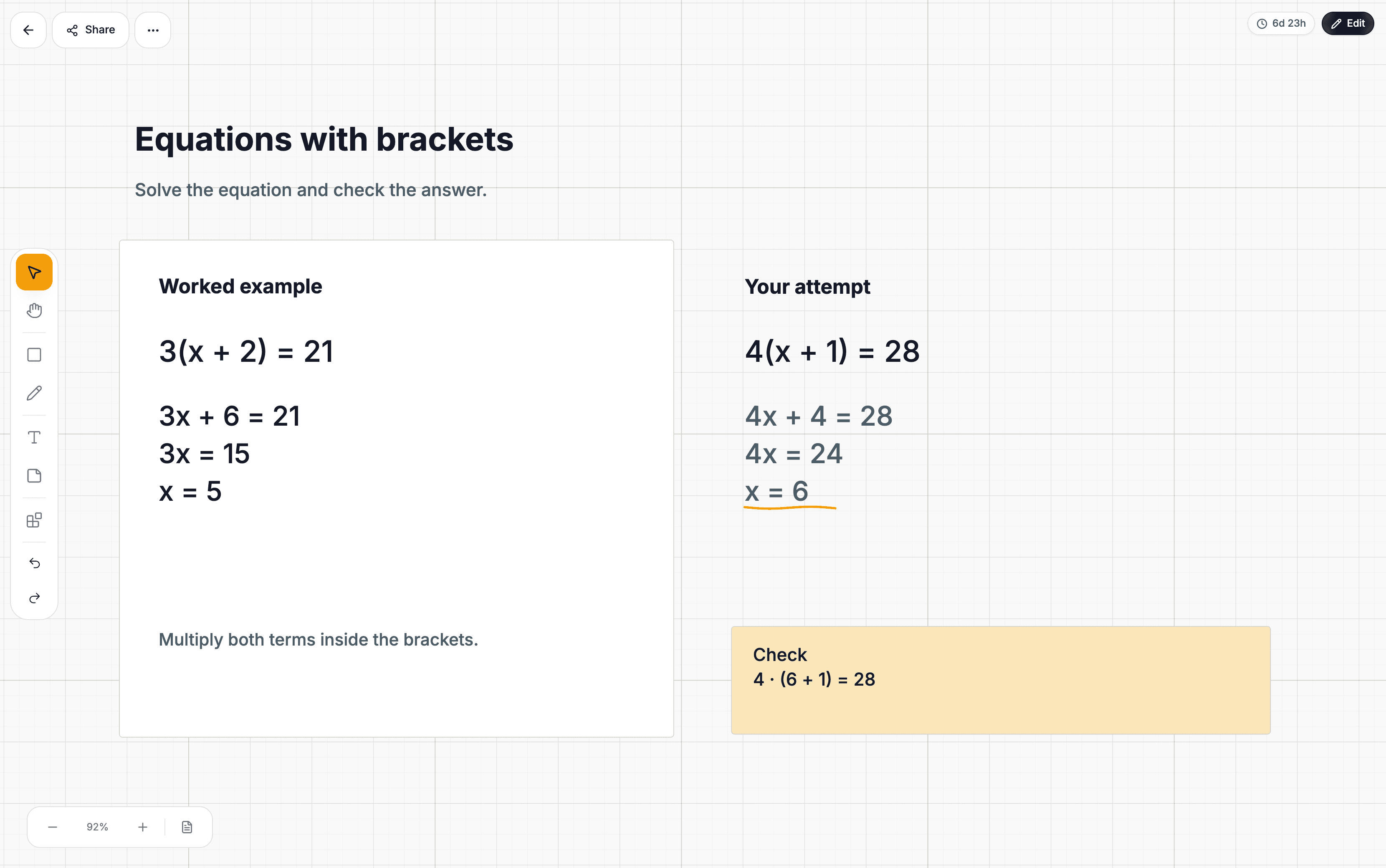
Show 3(x + 2) = 21. Write 3x + 6 = 21 and explain that step. In 4(x + 1) = 28, leave expanding the brackets to the student. Then give 5(x + 1) = 30 from the start.
“What is the first line without brackets? Explain it before you calculate.”
Stop explaining once they can choose the next step. If the mistake returns, compare two lines and set another short attempt.
Check with a new problem
Hide the earlier solutions. Give 2(x − 3) = 10. The student solves it and substitutes the answer. Then show the incorrect 2x − 3 = 10 and ask what differs.
“Which number should change, and why? Does your x work in the original equation?”
Record what they did independently and what still needed a question. The answer alone is not enough.
Close the lesson
Return to the goal. The student records one thing they can do and one to revisit. Set two short problems for later: one similar, one with a change of sign.
“How will you check next time that you expanded the brackets correctly?”
Begin the next lesson with one of these problems, without looking at the solution.
This is an example schedule, not a scientifically optimal allocation of minutes. Allow more time for diagnosis in a first session.
Print versionDecide what the student will do at the end
“We will cover equations” does not help you choose tasks or assess the session. Name something the student will do without being led through it. One goal is enough if you actually check it.
- Instead of
- Today we will revise equations with brackets.
- Try
- At the end, you will solve a new equation with brackets and check the answer by substitution.
Start with a task from memory
“Do you remember?” usually produces yes, sort of or no. A short task tells you more. Put away the notes and ask for a step, example or explanation. Give the student time to think; do not finish their sentence after two seconds.
Ask: “Tell me three things you did yesterday, without the verb list.”
Student: “Yesterday I go to school.”
Ask: “You mean yesterday. Which form of go do you need?” Then ask for a new sentence with a different verb.
Give the next step to the student
Show one step and explain why you take it. Leave the next line to the student. If they get stuck, offer a partly worked example and gradually remove the prompts.
Say to the student
“I expanded the brackets in the first example. In the second, you write that line. We will check the rest later.”
What to say when the student gets stuck
“I don’t know” can mean an unclear question, a missing first step or worry about making a mistake. Start with a question that helps you tell them apart.
“I don’t know” at the first step
Tutor: Read the question. What are we finding, and what have we been given? Write that down even if you cannot solve it yet.
The student guesses
Tutor: Leave the answer for a moment. Show the step that gets you there. How can we test your suggestion?
Waits for “is that right?”
“Finish these two steps. We will check them together when you are done.” Agree on when to check instead of judging every line.
Follows the example but cannot start
“You can explain my example. Now choose just the first step in a new one. Leave the calculations for later.”
Correct one point, then try again
Keep the work that is correct. Identify the first incorrect line rather than cross out a mostly successful solution. The student needs to know what to retain and what to change.
2(x + 3) = 14
2x + 3 = 14
2x + 6 = 14
Ask: “The two multiplies x. What does it do to the three in the same brackets?”
Ask for the corrected line and completion of the problem. Then give a similar equation with different numbers. A repeated mistake calls for comparison and another independent attempt, not another “be careful”.
Check understanding and leave a next step
“Do you understand?” can become permission to keep talking. Ask for something the student does: a new problem, an explanation in their own words or an error to find. Choose one short check that matches the lesson’s goal.
“Why do you multiply both terms inside the brackets?”
“Make up an equation whose answer is x = 3.”
“Without calculating: will expanding the brackets change the solution? Explain.”
I can: solve an equation with addition inside brackets and substitute the result.
Revisit: multiplying a term with a minus sign.
Next step: two short equations without notes; check one at the start of the next lesson.
Before the lesson
Prepare a few decisions, not a script for every sentence. Leave room to change the plan after the first task.
Take the plan into your next lesson
Copy the schedule and fill in your topic and tasks. The print version includes the plan, space for notes and the checklist. Your print dialog can also save it as a PDF.
The board opens with the lesson layout ready. Add your own tasks and share the link with the student.
No account needed. This temporary board expires after 7 days. Keep any materials you need before it expires.
What the guidance draws on
These sources cover choosing tasks, recalling knowledge and responding to mistakes. The problems, exchanges and timings were written for this guide.
- EEF — One to one tuition
Matching one-to-one work to identified learning gaps and monitoring progress.
- IES — Organizing Instruction and Study to Improve Student Learning
Revisiting material, alternating worked examples with problems and asking for explanations.
- EEF — Teacher Feedback to Improve Pupil Learning
Feedback that gives the student a specific correction to make.